
Compounded GLP-1 vs. FDA-Approved GLP-1 Medications: Safety, Risks & Key Differences in 2026
Compounded GLP-1 vs. FDA-approved GLP-1 medications: a friendly, plain-English guide to safety, legality in 2026, 503A vs. 503B pharmacies, dosing risks, and questions to ask before starting.
Dr. Elena Marsh
Endocrinologist
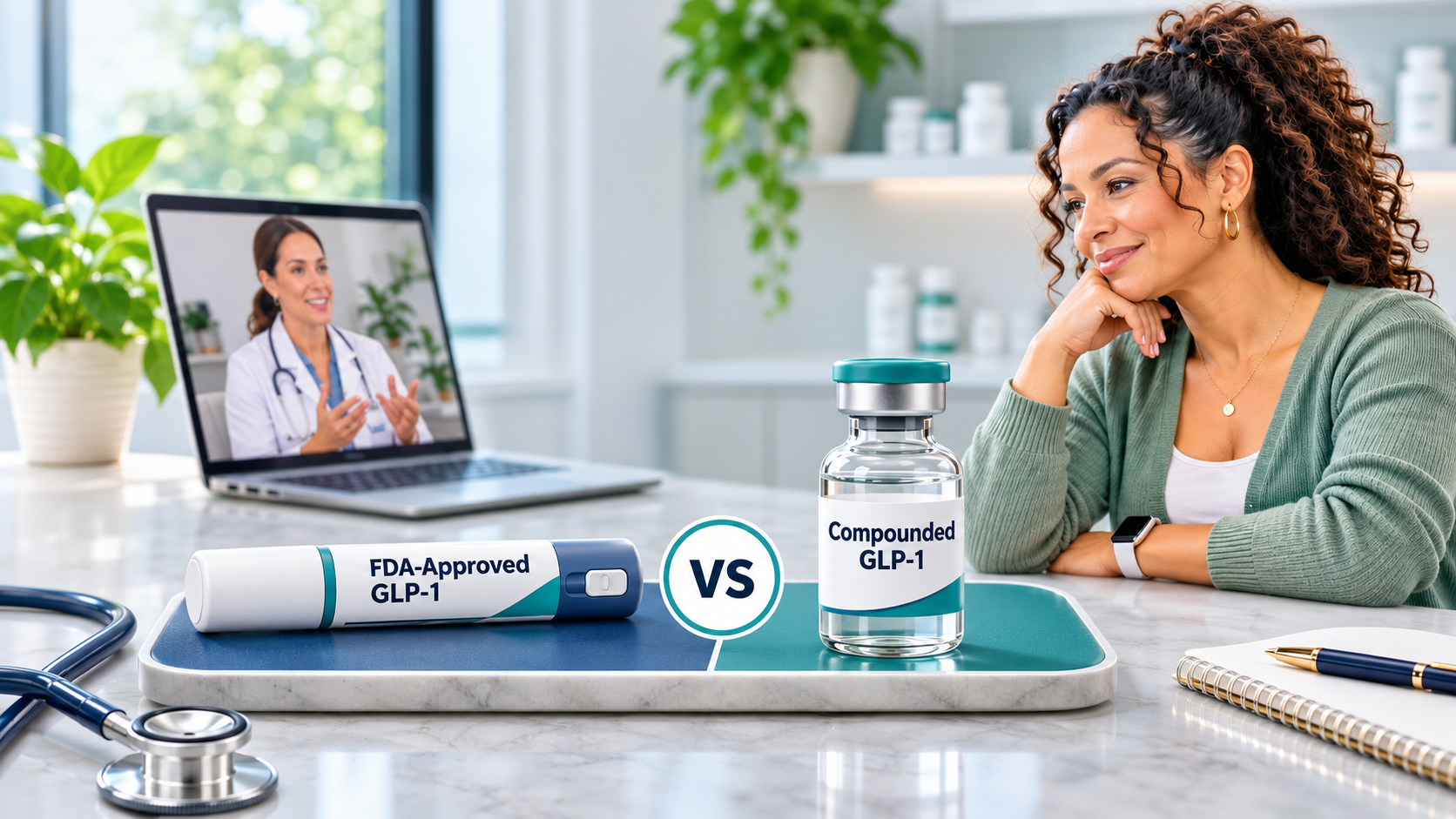
If you've searched for weight-loss treatment online, you've probably seen offers for compounded semaglutide or compounded tirzepatide alongside familiar brand names like Wegovy and Zepbound. The prices, packaging, and promises can look very similar — but the differences genuinely matter for your health and safety.
Here's the short answer: FDA-approved GLP-1 medications undergo rigorous FDA review of their safety, effectiveness, and manufacturing quality before they can be marketed to the public. Compounded GLP-1 medications do not undergo that product-specific approval process.
Lawful compounding can be valuable for certain patients who have a particular medical need that commercial drugs can't meet. However, a compounded medication is not an FDA-approved generic, and it shouldn't automatically be considered interchangeable with an approved medication.
So, which option should you consider? In this Meduva Health guide, we'll explain the differences, review the latest FDA rules, explore potential safety concerns, and share the exact questions you should ask before beginning any prescription weight-management treatment. For a refresher on how these medications work in your body, start with our GLP-1 weight loss guide or our head-to-head semaglutide vs. tirzepatide comparison.
What Are GLP-1 Medications?
GLP-1 stands for glucagon-like peptide-1, a natural hormone involved in appetite regulation, feelings of fullness, and blood sugar control. Prescription medications that act on GLP-1 receptors help eligible patients manage their weight as part of a medically supervised treatment plan.
Examples include:
- Wegovy (semaglutide): FDA-approved for weight management in eligible patients, with additional cardiovascular risk-reduction indications.
- Zepbound (tirzepatide): FDA-approved for long-term weight management in eligible adults and for certain adults with obesity and obstructive sleep apnea.
- Ozempic (semaglutide): FDA-approved for type 2 diabetes and certain related indications.
- Mounjaro (tirzepatide): FDA-approved for type 2 diabetes.
Although these medications may share active ingredients, the individual commercial products have different FDA-approved indications and prescribing information. The essential question is whether the specific medication you receive has undergone the FDA's thorough approval process.
What Is the Difference Between Compounded GLP-1s and FDA-Approved GLP-1s?
FDA-Approved GLP-1 Medications
Before approving a prescription drug, the FDA evaluates clinical trial evidence concerning its safety and effectiveness for proposed uses, along with detailed data on manufacturing, purity, and quality controls. For patients, FDA approval provides an established regulatory framework and verified consistency for that particular medication.
However, FDA approval does not mean a drug is risk-free, suitable for everyone, or guaranteed to produce a specific result — which is why ongoing clinician oversight is always essential.
Compounded GLP-1 Medications
Compounding generally involves combining, mixing, or altering drug ingredients to meet a particular patient's medical need. For example, a clinician may identify a specific allergy, dye intolerance, or formulation requirement that an available commercial drug cannot meet.
Compounded medications are prepared through legally recognized compounding pathways. However, compounded semaglutide and compounded tirzepatide are not FDA-approved medications. The FDA does not evaluate each compounded formulation for safety, effectiveness, or batch-to-batch quality before marketing.
This doesn't mean every lawfully compounded medication is automatically unsafe. It means compounded medications do not carry product-specific FDA approval. A compounded GLP-1 is also not an FDA-approved generic version of Wegovy or Zepbound.
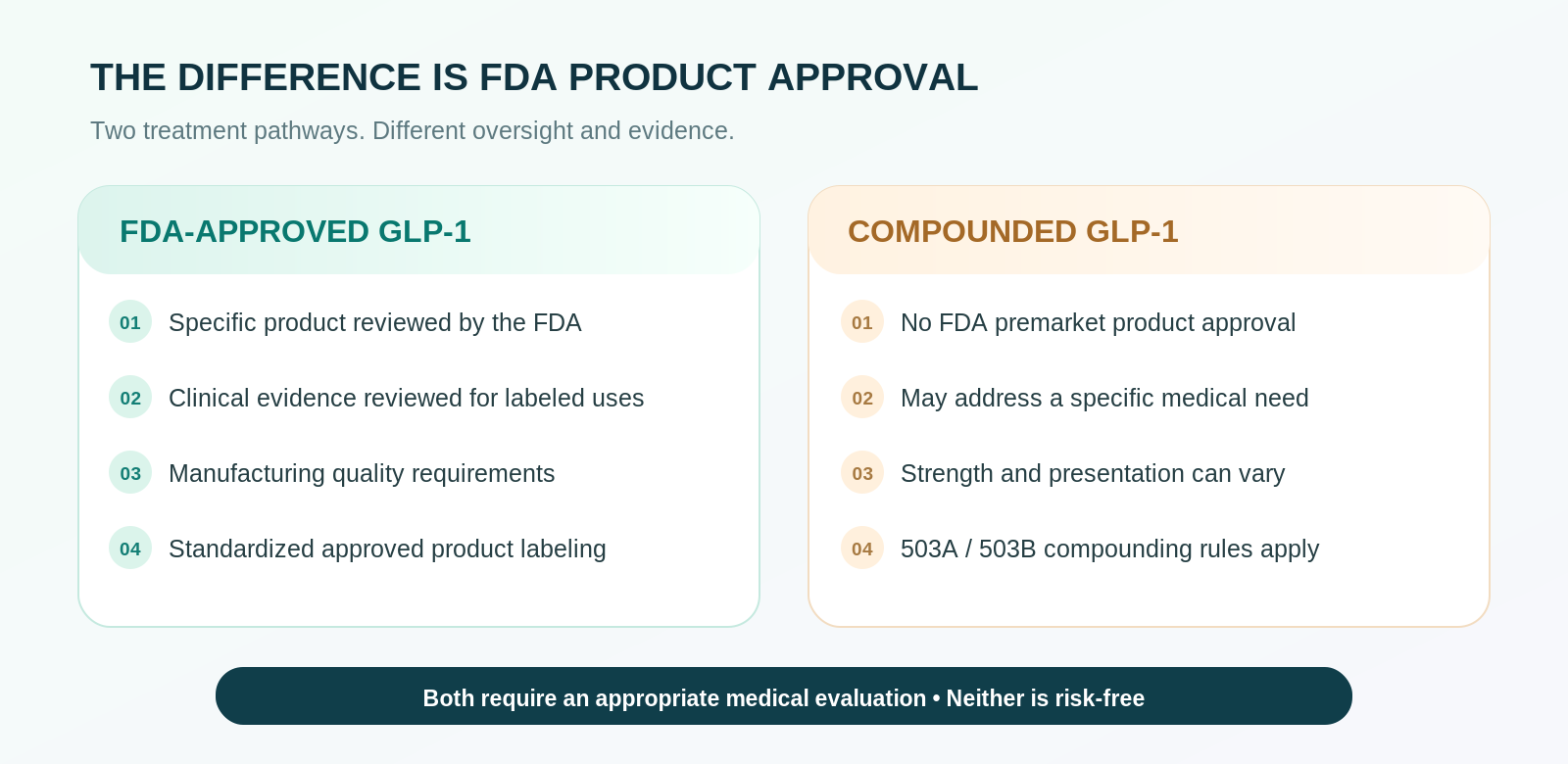
Compounded GLP-1 vs. FDA-Approved: Side-by-Side Comparison
| Feature | FDA-approved GLP-1 | Compounded GLP-1 |
|---|---|---|
| FDA approval | Yes, for the specific product | No |
| Clinical evidence | Reviewed for approved uses | Brand trial results cannot automatically be applied |
| Manufacturing | FDA manufacturing and quality requirements | Requirements depend on the compounder |
| Formulations | Approved strengths and presentations | May vary based on specific medical needs |
| Dosing instructions | Standardized approved labeling | Can differ between formulations |
| Generic status | Brand products have their own FDA approvals | Not an FDA-approved generic |
| Pricing | Varies by product and coverage | Varies by pharmacy and treatment arrangement |
Are Compounded Semaglutide and Tirzepatide Still Legal in 2026?
This is one of the most critical questions patients ask. The answer: certain compounding may remain lawful when specific medical requirements are met — but routine copying is restricted.
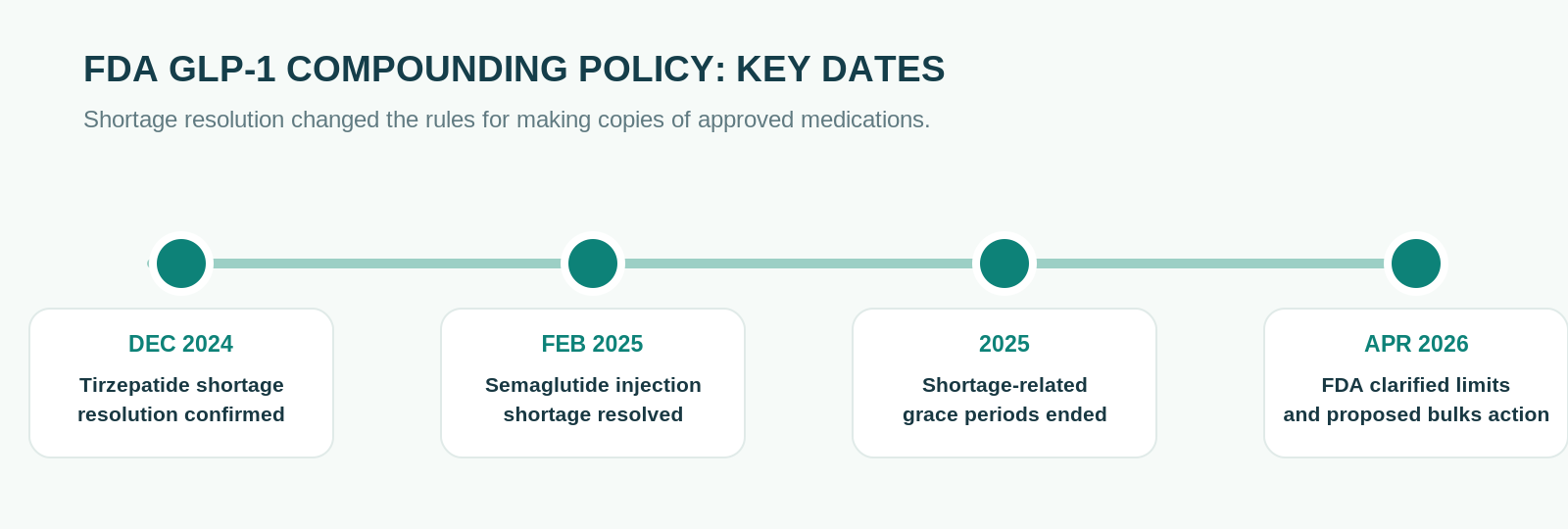
Previously, nationwide shortages of semaglutide and tirzepatide affected the circumstances in which certain compounded products could be prepared. The FDA subsequently confirmed:
- The tirzepatide injection shortage was resolved in late 2024.
- The semaglutide injection shortage was resolved in February 2025.
- Temporary shortage-related enforcement-discretion periods ended in 2025.
In April 2026, the FDA reaffirmed restrictions on compounding medications that are essentially copies of commercially available FDA-approved products. Certain individualized compounding may still be possible under applicable laws, such as circumstances involving a documented, clinically significant difference for an identified patient.
However, lower cost or consumer preference alone does not establish that a compounded copy meets legal requirements.
The rules also differ between traditional pharmacy compounding under section 503A and outsourcing facilities under section 503B. In April 2026, the FDA stated that semaglutide and tirzepatide were not on the relevant 503B bulk-substances list or the FDA drug-shortage list, and proposed excluding these substances from the 503B bulks list.
What Is the Difference Between a 503A and 503B Compounding Pharmacy?
Understanding these two categories helps explain why not all compounded medications operate under the exact same requirements.
Section 503A: Traditional Compounding Pharmacies
This section covers compounding by licensed pharmacists or physicians for individual patients with valid, patient-specific prescriptions. State boards of pharmacy play the primary oversight role. Products compounded in compliance with section 503A may qualify for exemptions from certain federal requirements, including premarket drug approval and federal current good manufacturing practice (CGMP) standards.
Section 503B: Registered Outsourcing Facilities
Section 503B governs registered outsourcing facilities. These facilities are subject to additional federal requirements, including CGMP standards, risk-based FDA inspections, and mandatory adverse-event reporting. However, receiving medication from an FDA-registered 503B outsourcing facility does not mean the compounded medication itself is FDA-approved.
Five Important Safety Considerations With Compounded GLP-1s
1. Medication Dosing Errors
The FDA has reported significant dosing errors involving compounded injectable semaglutide, including cases requiring emergency room visits and hospitalization. Some errors occurred when patients or healthcare professionals confused milligrams (mg), milliliters (mL), and syringe units.
Different concentrations and multidose vials can make incorrect dose calculations especially dangerous. Patients should never calculate their own unit conversions or guess how much medication to inject.
2. Different Salt Forms of Semaglutide
Some compounded products have contained semaglutide sodium or semaglutide acetate. The FDA states that these salt forms are chemically different active ingredients from the base semaglutide used in FDA-approved medications. The agency has stated it is not aware of any lawful basis for their use in compounding. Patients should always confirm the exact active ingredient with their prescriber and dispensing pharmacy.
3. Compounded GLP-1s Combined With Vitamins
You may see compounded semaglutide advertised with vitamin B12, vitamin B6, or other added ingredients. These combinations are sometimes marketed as offering extra energy or nausea reduction.
However, the FDA has stated that the safety and effectiveness of combining semaglutide with these additional ingredients have not been clinically established. Adding B12 does not make a compounded medication legally distinct from an approved product or confer FDA approval.
4. Improper Storage and Temperature Control
Injectable GLP-1 medications are peptides that require consistent refrigeration and cold-chain shipping. The FDA has received complaints of compounded injectable GLP-1 products arriving warm or without adequate cooling packs.
If a shipment arrives warm, inadequately refrigerated, damaged, or suspicious, do not inject it until you have contacted the dispensing pharmacist or your clinician.
5. Misleading Online Marketing
The FDA has issued warning letters to online sellers and telehealth platforms about deceptive marketing practices. Red flags include:
- Advertising compounded medications as "identical" or "generic" versions of FDA-approved products.
- Dispensing prescription medication without genuine, thorough medical screening.
- Failing to identify the licensed dispensing pharmacy.
- Selling products labeled "for research purposes only" rather than for human treatment.
- Making unsupported claims about zero side effects or guaranteed weight loss.
Patients should always be able to verify their prescriber's license, the pharmacy's credentials, exact medication details, and a clear follow-up plan.
Are Compounded GLP-1s as Effective as FDA-Approved Medications?
There is insufficient product-specific clinical evidence to assume that compounded formulations are equivalent to FDA-approved Wegovy or Zepbound. The clinical trials supporting FDA-approved products (such as the landmark SURMOUNT-5 trial) evaluated specific formulations, standardized doses, and tightly controlled manufacturing processes.
Those trial results cannot automatically be applied to a compounded formulation. For example, a clinic should never promise that the 20.2% weight loss seen with branded tirzepatide in clinical studies is guaranteed with a compounded version. The responsible conclusion is that compounded products have not undergone the same FDA product-approval evaluation.
How to Evaluate a GLP-1 Telehealth Provider
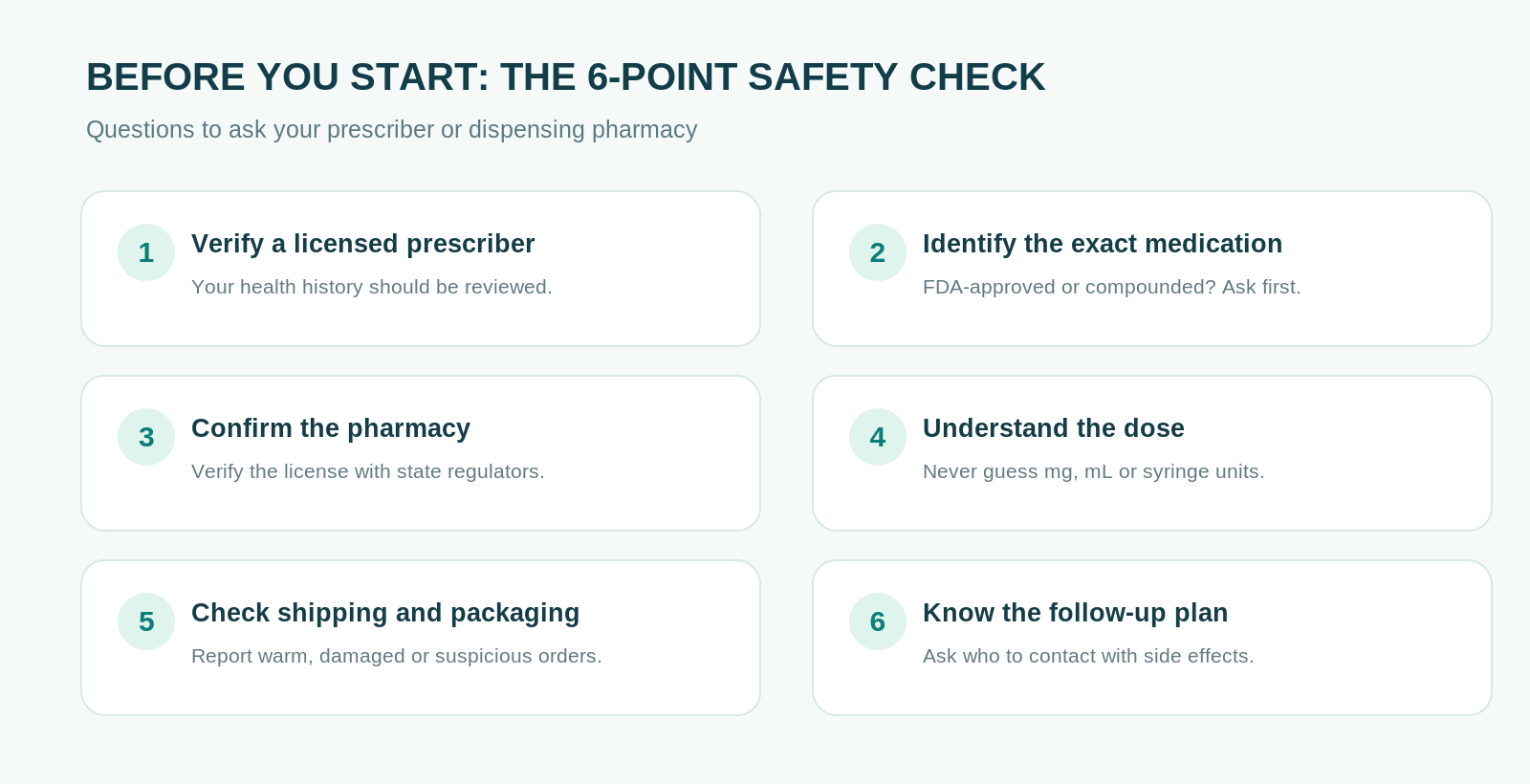
Before beginning treatment with any clinic or telehealth platform, walk through this 6-point safety check:
1. Who is prescribing my medication? Confirm your clinician is appropriately licensed in your state and thoroughly reviews your medical history.
2. Is the medication FDA-approved or compounded? Ask for the exact brand, product name, and active ingredient.
3. If compounded, why is it medically necessary? Your prescriber should explain the individualized clinical rationale.
4. Which pharmacy will dispense it? Verify its license with your state board of pharmacy or through FDA verification tools.
5. Will I receive clear dosing instructions? Make sure you understand the exact dose, concentration, syringe type, and administration steps.
6. What ongoing support is available? Ask who to contact if you experience side effects, how titration is monitored, and how follow-up visits work.
You can use the FDA BeSafeRx resources to verify state-licensed online pharmacies.
Which GLP-1 Treatment Option Is Right for You?
Choosing a prescription weight-management medication requires more than comparing prices or social media ads. A qualified healthcare professional should evaluate your complete medical history, personal goals, contraindications, previous treatments, and access to long-term follow-up care.
For eligible patients, available FDA-approved treatments provide the clearer product-specific clinical evidence and rigorous regulatory approval pathway. Lawful compounding can still serve certain individualized medical needs that available commercial products cannot meet.
The best next step is an open, informed discussion with a licensed clinician — not assuming that either option is automatically right for everyone. To learn more about building sustainable lifestyle habits alongside medical therapy, see our guides on protein for weight loss, movement that sticks, and metabolism myths.
Frequently Asked Questions About Compounded GLP-1s
Is compounded semaglutide the same as Wegovy?
No. Wegovy is an FDA-approved semaglutide product manufactured under strict federal quality standards. Compounded semaglutide is a non-FDA-approved preparation and is not an FDA-approved generic version of Wegovy.
Is compounded tirzepatide the same as Zepbound?
No. Zepbound is an FDA-approved tirzepatide medication with proven clinical trials and approved labeling. Compounded tirzepatide does not undergo that product-specific approval process.
Are all compounded GLP-1 medications illegal?
No. Certain compounding may be permitted under federal and state law when specific clinical requirements are met — such as an individualized formulation need. However, routine copies of commercially available FDA-approved drugs are restricted now that national shortages have resolved.
Is a 503B compounded medication FDA-approved?
No. A registered 503B outsourcing facility is subject to CGMP standards and risk-based FDA inspections, but its individual compounded products are not FDA-approved drugs.
Does adding vitamin B12 make compounded semaglutide safer or better?
There is not sufficient clinical evidence to establish that combining semaglutide with additional ingredients improves safety or effectiveness. Adding B12 does not confer FDA approval or alter the medication's regulatory status.
What should I do if my medication arrives warm or I don't understand the dose?
Do not inject it until you have spoken directly with your dispensing pharmacist or prescriber. If you experience severe symptoms, seek medical attention promptly, and get emergency care for any signs of a severe allergic reaction.
Key Takeaways: Compounded vs. FDA-Approved GLP-1s
- FDA-approved GLP-1s (Wegovy, Zepbound) undergo rigorous premarket review for safety, effectiveness, and manufacturing quality. Compounded GLP-1s do not.
- Compounded GLP-1s are not FDA-approved generics and brand clinical trial results cannot automatically be applied to them.
- With national shortages resolved, FDA rules strictly restrict making routine copies of commercially available approved drugs.
- Major safety considerations include dosing calculation errors, unapproved salt forms (semaglutide sodium/acetate), cold-chain shipping failures, and deceptive online marketing.
- Always verify your prescriber's license, the dispensing pharmacy, the exact active ingredient, and clear dosing instructions before starting treatment.
- The safest path is a transparent consultation with a licensed clinician who reviews your full health history.
For authoritative regulatory updates, explore the U.S. FDA Human Drug Compounding guidance and the FDA alerts on unapproved GLP-1 drugs.
Medical disclaimer: This article is for educational purposes only and is not medical advice. Always consult a licensed healthcare professional before starting, changing, or stopping any treatment.
Related reading

Semaglutide vs. Tirzepatide: Which GLP-1 Weight Loss Medication Is Right for You?
Semaglutide vs. tirzepatide: a friendly, plain-English comparison of the two leading GLP-1 weight loss medications — how they work, what the SURMOUNT-5 trial found, side effects, and how to choose with a clinician.
Dr. Elena Marsh
Endocrinologist
GLP-1 Medications: A Complete Guide to Safe, Sustainable Weight Loss
GLP-1 receptor agonists have transformed obesity medicine. Here's a friendly, plain-English guide to how they work, who they're for, and how to use them alongside lasting lifestyle change.
Dr. Elena Marsh
Endocrinologist
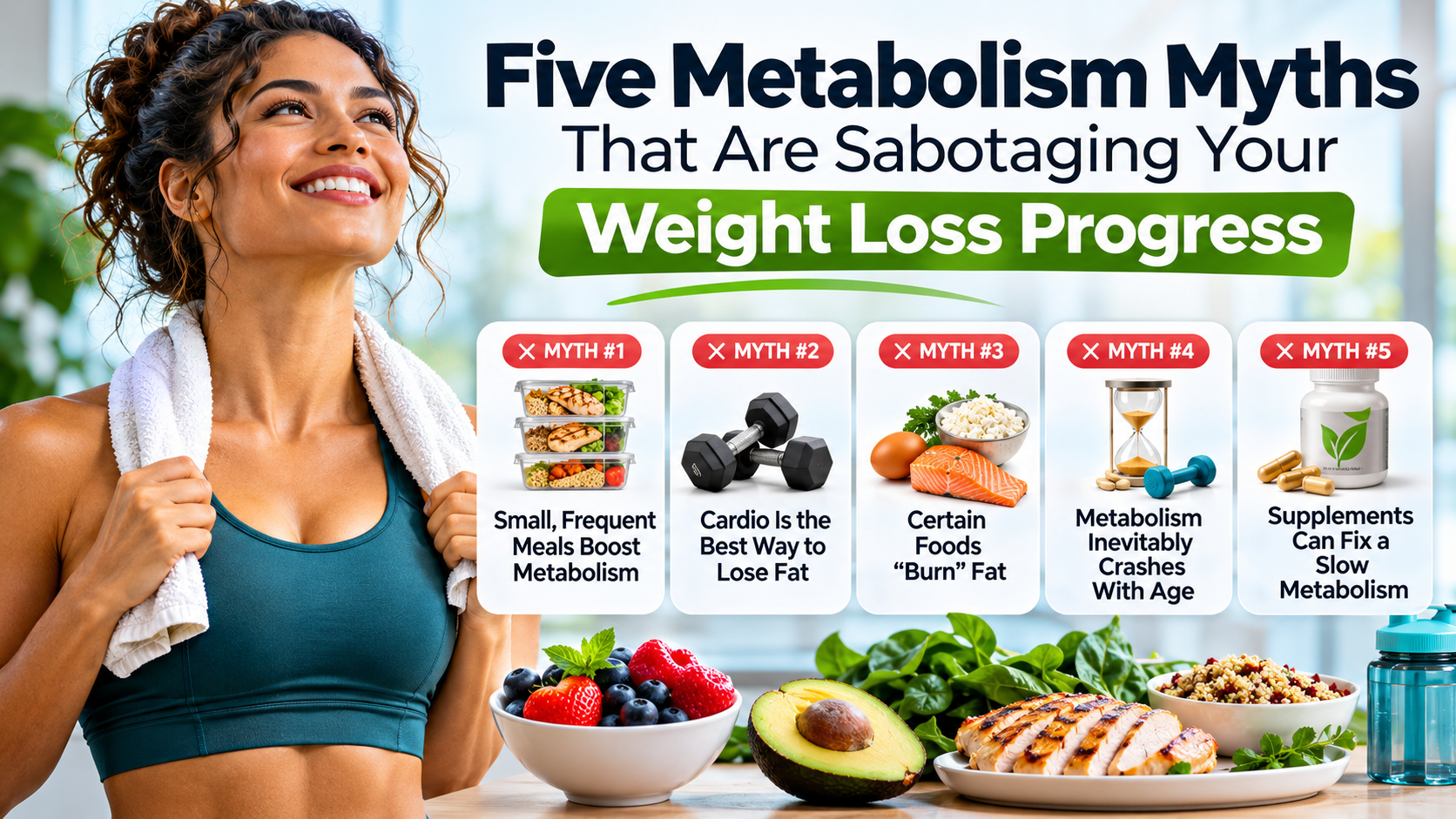
Five Metabolism Myths That Are Sabotaging Your Weight Loss Progress
From 'eating six meals speeds metabolism' to 'cardio is king,' let's separate the science from the folklore so you can stop wasting effort and start seeing results.
Nadia Brooks, RD
Registered Dietitian